
Dear 2120,
I want to tell you about a book called Antimemetics and why it matters – both now and hopefully for you too. It’s about ideas that don’t spread. Not because they’re bad, but because they’re too complex, too uncomfortable, or too inconvenient to go viral. Memes spread everywhere. Antimemes just… vanish. They leave barely any trace except in quiet corners where people are actually paying attention.
This hits different right now, to stay in the parlance of meme culture, because of how our platforms work. Everything’s optimized for speed and visibility. The ideas that win aren’t the most important ones – they’re just the loudest, the catchiest, the most entertaining. Meanwhile, the slow stuff, the complicated truths about climate and justice and how we actually relate to each other get buried. Antimemetics gives us language for that. For what disappears even though it matters.
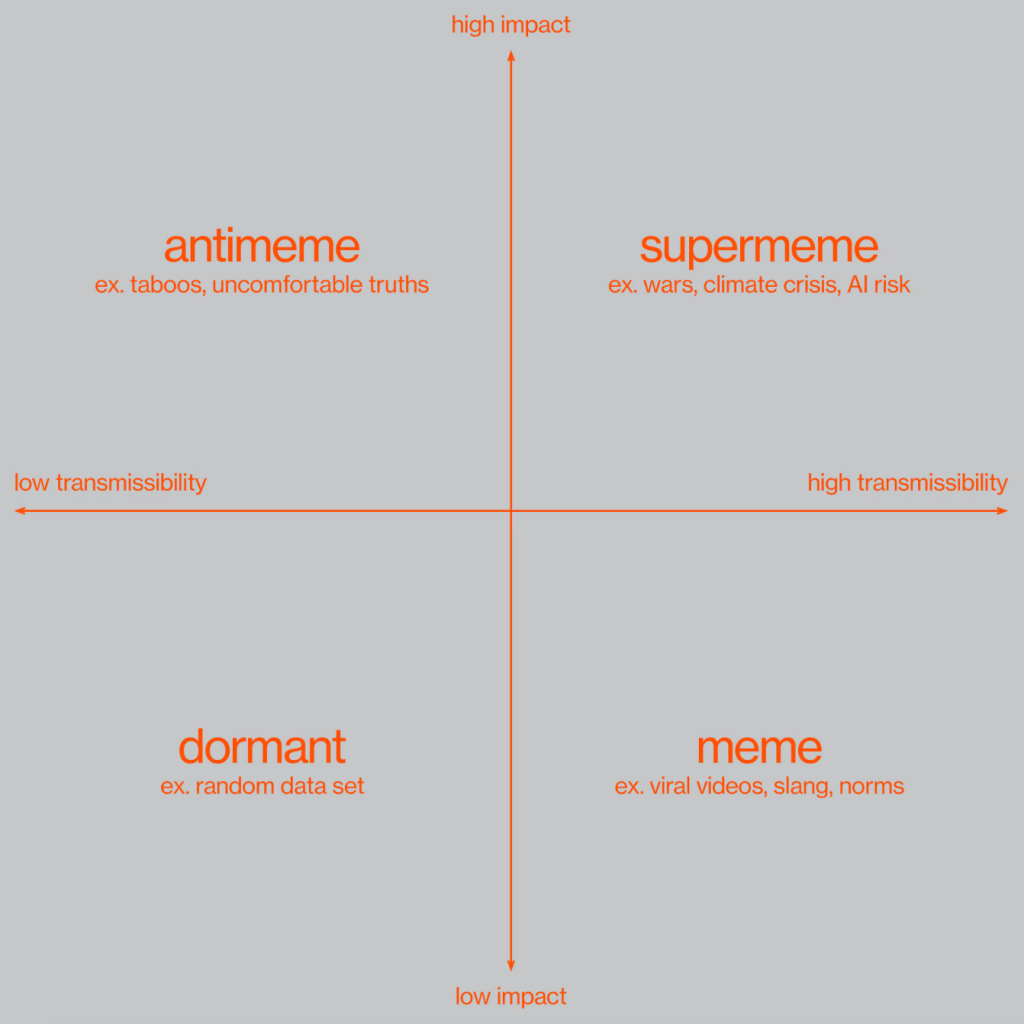
Here’s what’s interesting from a futures perspective: if attention is our main currency, then invisibility becomes a kind of resistance. The ideas that refuse to be broadcast: cooperative economies, regenerative systems, ways of valuing things beyond money. Those might be the real foundation of whatever comes after capitalism.
Bifo Berardi wrote about how late capitalism exhausts our attention, and how that exhaustion might open up new ways of thinking. David Graeber showed how everyday cultural practices can hide radical possibilities. Italo Calvino reminded us that entire worlds can exist in the imagination if we bother to look. They’re all pointing at the same thing: the invisible is where new worlds grow.
A century from now, you might look at Antimemetics as a snapshot of a weird transition period. A time when the most important ideas couldn’t compete for attention. When what shaped culture was as much about what was absent as what was everywhere. You might trace back to the quiet networks and experimental practices that survived in the margins The stuff we couldn’t see clearly but that somehow carried us forward. All our viral spectacles will look silly, but those invisible signals might be what actually mattered.
I’m writing this because paying attention is the first step of caring about something. Cultivating the invisible means cultivating possibility. Antimemetics teaches us to notice what resists the algorithm, to follow what doesn’t want to be broadcast, and to protect the seeds of ideas that might actually build something lasting.
Antimemetics: Why Some Ideas Resist Spreading
 Letters to 2120