We’re Cooked (again)

Dear 2120,

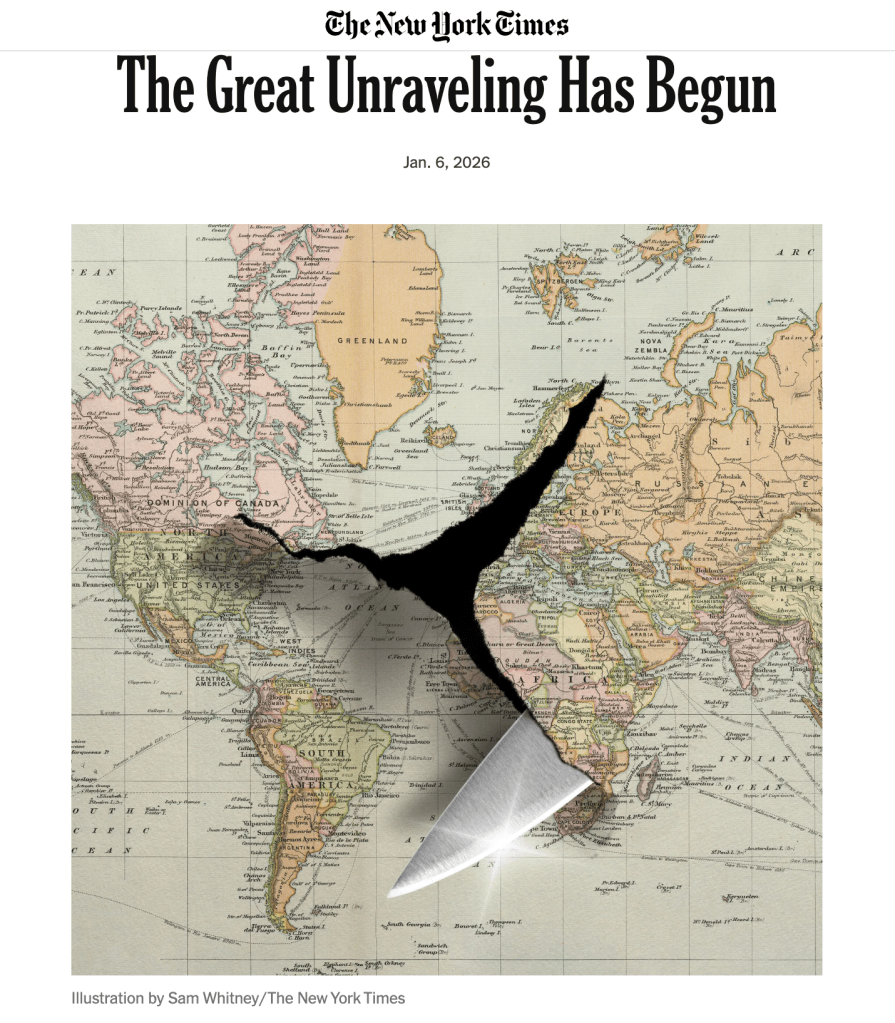
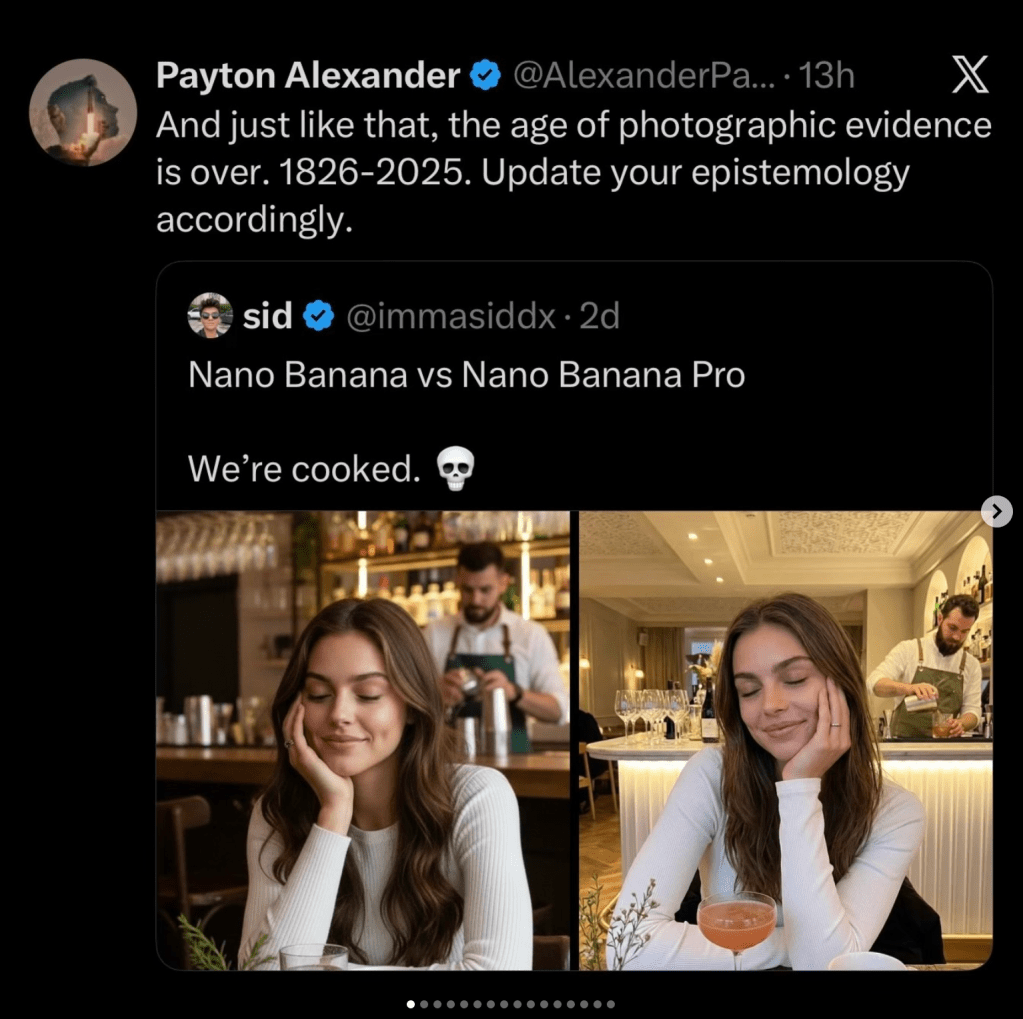
Reality is coming apart at the seams, it would seem. If you’re wondering why I haven’t sent you an AI-themed letter yet, it’s mostly because: A) I’d like to try and forget the work and money it’s costing me as a person who makes a living writing things, and B) the indisputable fact that the legions of people who yap incessantly about AI here in 2025 are among the most insufferable members of our species.

This caught my attention, however. Made me think The Matrix wasn’t a pipe dream – and maybe not even that far away.

RIP, the real world.

How Fossil-Fueled Expansion Engineered Our Obsession With Newness and Reinvention

Still from Paul Thomas Anderson’s ‘There Will Be Blood’ (2007)

Dear 2120,

I hope you’re settled. Because we’re not. We’re addicted to newness. New stuff, new looks, new versions of ourselves. It feels totally normal, but it’s actually a pretty recent thing, engineered by cheap fossil fuels and the insane growth they made possible.

How It Started

Fossil fuels powered more than factories. They rewired how we think about stuff and identity. When production exploded in the 20th century, buying things became who you are. “New” turned into shorthand for progress, success, basically everything good.

Cities powered by cheap energy became testing grounds for different lifestyles. Novelty stopped being special and became expected. Your identity became something you’re supposed to constantly upgrade.

Breaking Rules Became the Rule

Fast change made disruption a virtue. People who broke boundaries became heroes. The growth-at-all-costs mindset loved rule-breakers because they suggested more expansion was possible.

This logic runs everything now. Tech worship “disruption.” Culture chases the next edgy thing. If you’re not breaking something, you’re boring. Transgression went from rebellious to required.

The Reinvention Hamster Wheel

Global supply chains and social media algorithms cranked this into overdrive. Now we cycle through trends and identities constantly. Reinvention went from meaningful choice to compulsive behavior. Staying the same feels like stagnation. Change became convention.

You end up with this restless psychology where you have to keep reinventing yourself just to feel relevant.

When Reality Isn’t Enough

Umberto Eco wrote about how we became obsessed with making things that feel more real than reality. Prosperity stopped being about actual material comfort and became a vibe you engineer. We remake reality to be louder, shinier, more intense every time.

The ‘new’ is addictive because you can always design it to feel better than what actually exists. Culture turned into an escalation machine where each iteration has to top the last one.

The Dark Side

Paul Thomas Anderson’s There Will Be Blood shows where this psychology goes. Daniel Plainview builds an oil empire through pure conquest. He violates every boundary to expand and dominate. Competition defines his whole identity. He wants wealth for the myth of it, not what it provides. Prosperity as spectacle.

And where does it end? Isolation and self-destruction. That’s what happens when transgression becomes your whole personality.

What It Cost Us

This mindset gave us climate chaos, biodiversity collapse, and depleted resources. But it also did internal damage; constant restlessness, insecurity, loss of meaning.

Transgression used to challenge power structures. Now the system just absorbed it and uses it as fuel for faster cycles of consumption and novelty.

What’s Next

We need to rethink what prosperity, desire, and creativity even mean. Stuff like degrowth, regenerative design, doughnut economics: these show how novelty can come from restoration instead of extraction.

The goal is redirecting creativity and transgression, not killing them. Transgression can mean breaking with the logic of “more, faster, louder” itself. Reinvention can mean getting back to balance. Novelty can mean building things that actually last.

The 20th century trained us to crave endless newness. We escalated that into fake realities that feel more abundant than real life (Eco). We built a psychology of conquest disguised as ambition (Anderson).

The myth we inherited says progress has to break boundaries. Always. Forever.

But there’s a different way. Value having enough over having more. Depth over escalation. Sticking with things over constant reinvention. Transgression as refusing the destructive playbook we were handed, not as domination.

That’s the shift we’re trying to figure out. I hope for our sake and yours that it does.

Aphex Twin Just Dropped Two New Tracks

Dear 2120,

Aphex Twin, ‘the electronic Mozart’ of our era, just uploaded two tracks to SoundCloud. The description says he’s annoyed about UK rain and there are “probably better mixes” he’ll share if he finds them.

That’s it. 

Everything online is supposed to be polished and optimized to compete for attention. But he’s been using SoundCloud like a messy folder, just dropping rough recordings and sketches whenever. No strategy. 

It’s small, but it matters. Not everything has to be content. Not everything has to be finished. Some stuff can just exist for people who are actually listening.

Maybe you’ll look back and see this as artists learning to opt out of the content mill. Or maybe by then it’ll just be normal to share work without needing it to perform.

Antimemetics: The Death of the ‘When’ Meme

Dear 2120,

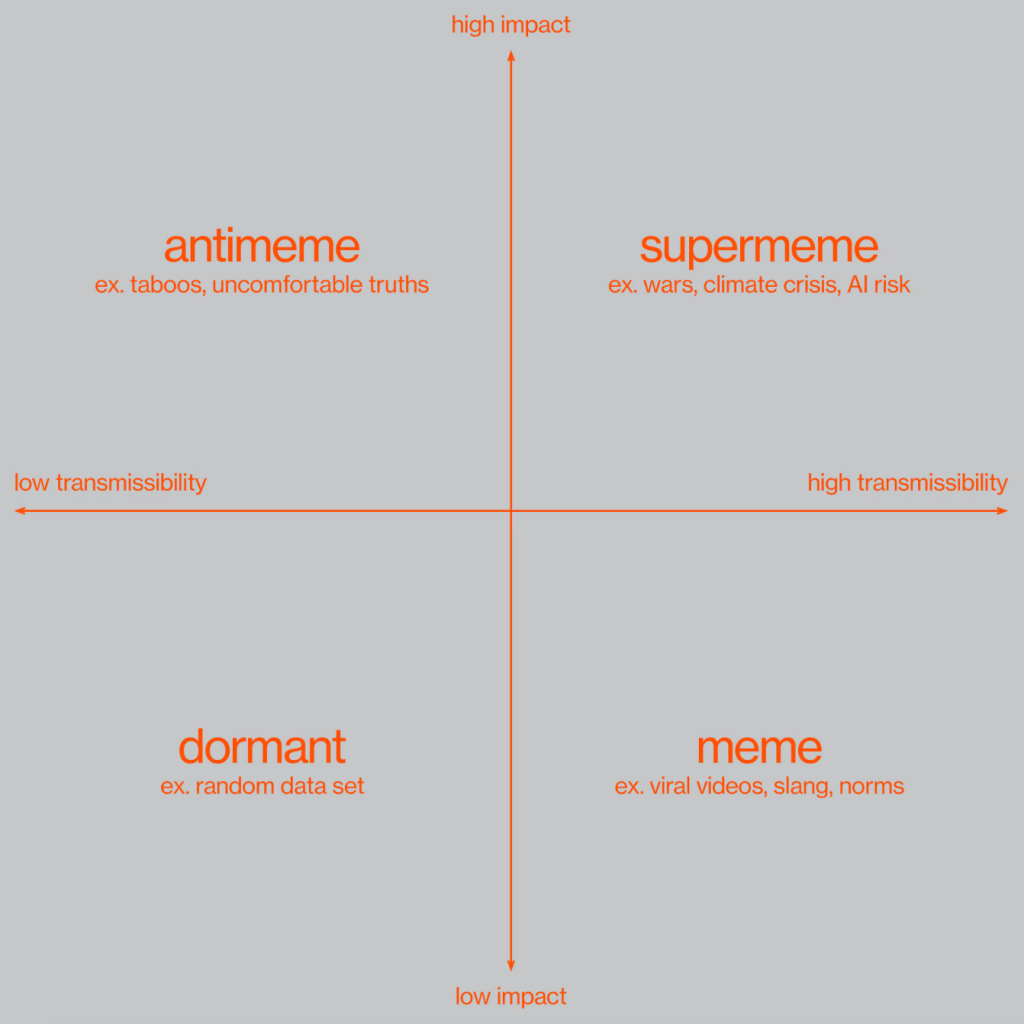
I want to tell you about a book called Antimemetics and why it matters – both now and hopefully for you too. It’s about ideas that don’t spread. Not because they’re bad, but because they’re too complex, too uncomfortable, or too inconvenient to go viral. Memes spread everywhere. Antimemes just… vanish. They leave barely any trace except in quiet corners where people are actually paying attention.

This hits different right now, to stay in the parlance of meme culture, because of how our platforms work. Everything’s optimized for speed and visibility. The ideas that win aren’t the most important ones – they’re just the loudest, the catchiest, the most entertaining. Meanwhile, the slow stuff, the complicated truths about climate and justice and how we actually relate to each other get buried. Antimemetics gives us language for that. For what disappears even though it matters.

Here’s what’s interesting from a futures perspective: if attention is our main currency, then invisibility becomes a kind of resistance. The ideas that refuse to be broadcast: cooperative economies, regenerative systems, ways of valuing things beyond money. Those might be the real foundation of whatever comes after capitalism.

Bifo Berardi wrote about how late capitalism exhausts our attention, and how that exhaustion might open up new ways of thinking. David Graeber showed how everyday cultural practices can hide radical possibilities. Italo Calvino reminded us that entire worlds can exist in the imagination if we bother to look. They’re all pointing at the same thing: the invisible is where new worlds grow.

A century from now, you might look at Antimemetics as a snapshot of a weird transition period. A time when the most important ideas couldn’t compete for attention. When what shaped culture was as much about what was absent as what was everywhere. You might trace back to the quiet networks and experimental practices that survived in the margins The stuff we couldn’t see clearly but that somehow carried us forward. All our viral spectacles will look silly, but those invisible signals might be what actually mattered.

I’m writing this because paying attention is the first step of caring about something. Cultivating the invisible means cultivating possibility. Antimemetics teaches us to notice what resists the algorithm, to follow what doesn’t want to be broadcast, and to protect the seeds of ideas that might actually build something lasting.

Antimemetics: Why Some Ideas Resist Spreading


Imagining 2120: Generating Desire for Postcapitalism

Dear 2120,

Writing to you feels weird. Like texting someone who won’t read it for a century. But here we are, stuck between a world that’s clearly breaking and one we haven’t figured out how to build yet.

Here’s the thing: we’re supposed to imagine the future, but we’re really bad at it. Most of what we get fed is either dystopian nightmares or the same capitalism we have now, just with fancier phones and flooded cities. Mark Fisher (quoting Jameson) said it’s easier to imagine the end of the world than the end of capitalism. He/they nailed it.

But something’s definitely shifting. People are starting to realize that what we want – like, actually want – matters politically. Our desires either keep this broken system running or help bring something new into being.

Ursula Le Guin said the future is a kind of fiction, and she was right. We don’t have to accept Silicon Valley’s depressing version as the only story. We can write different ones. Slower, weirder, more human.

There’s this idea from Jacques Attali that every dying system contains hints of what comes next. And yeah, we’re definitely dying; supply chains failing, climate chaos, institutions crumbling. But in all that noise, we’re hearing something else. Mutualism replacing rigid hierarchies. Local communities thriving within global networks. Economies that measure health instead of just growth. The next thing isn’t going to show up complete, it’s emerging in pieces, visible in the cracks.

The problem is we’ve been trained to want the wrong things. We’re addicted to ownership, competition, endless accumulation – and these habits keep us locked into a system that’s literally killing us. Even people who want change often want it to be easy, comfortable, something they can buy into without real disruption.

So the challenge isn’t just building new systems. It’s rewiring how we imagine life itself. Making the postcapitalist world feel not just possible but genuinely desirable.

What if creativity wasn’t about competing but about contributing? What if technology helped people and ecosystems thrive instead of extracting from them? What if pleasure came from connection rather than consumption? What if status meant what you gave, not what you owned? What if growth meant maturing, not just expanding?

Writing to you instead of just about you changes something. It makes you real – not some abstract concept but someone we’re in relationship with. You’re not a prediction; you’re who comes after us. And you’ll inherit both our mess and whatever we manage to get right.

We’re trying to build you something that doesn’t eat itself. A world where abundance is about ecology, not money. Where resilience is collective, not just a personal brand. Where liberation includes everyone or it’s meaningless.

If we pull this off, your world will seem obvious. Just like feudalism looks absurd to us now, our obsession with markets and competition and individual success will seem embarrassingly primitive to you. Maybe you’ll laugh at how we measured everything in productivity and profit. Or maybe you’ll just be relieved we finally moved on.

I’m not writing this as prophecy – more like a reminder that we can shape what we want. Desire isn’t fixed. We can redirect it. The future isn’t something we just watch happen. It’s something we create.

If we learn to want different things, we’ll build different things.

And if we build different things, maybe you’ll inherit a world that actually works.

We’re still figuring it out. But we are actually trying.

At the Edge of Whatever’s Next

Dear 2120,

Four years have gone by since my last letter. Apologies. The years have been eventful. I have two kids now, and a bunch of other things eating up my time here in late-stage capitalism, rendering unpaid writing, ruminating on the state of the world, outside of my immediate priorities. Still, I managed to squeeze in this message from early 2025 to let you know how I’m doing.

I hope you’re hanging in there. Chances are you might not be hanging in there. If the recent trajectory maintains its exponential nosedive, the letter I’m currently writing will find you in some sort of next-level chaos that our tiny minds can’t even begin to comprehend. To put it bluntly, we’re doing a spectacularly shitty job of protecting the future. I don’t mean to sound needy or act all weird about it, but I genuinely hope you’re okay.  

As I type these words into an oligarch-powered digital void, the world’s dominant superpower is getting hijacked by power-hungry techno-authoritarians. It’s very intimidating, but not without its farcical, clown-like elements; it weirdly feels like we’re stuck in some future comedy sketch about the 2020s — with Trump playing the cartoonish capitalist villain, all filtered through whatever distorted, misremembering history books you guys have left. 

And that’s just politics. We’ve got a polycrisis on our hands:

  • Oceans being killed
  • Forests vanishing
  • Soil turning to dust
  • Big animals being wiped out
  • Insects disappearing
  • Mass extinctions accelerating
  • Plastic literally in our bloodstreams
  • Climate scientists basically screaming into the void
  • Endless wars and genocide   

Oh, and did I mention the asteroid coming to kills us all, or the methane bubble in the Arctic that might burst, annihilating every living thing in its wake like some flatulent sleeper assassin the size of a small country? Some academics are even saying that AI could mean the end of civilization. I mean…why not throw a flesh-eating, zombie-virus into the mix to keep things interesting?

The whole thing feels like whoever’s running this simulation suddenly got bored and started throwing random disasters at us. Like, ‘Let’s make Elon go off the rails! Send a hot, weird girl his way, make her break up with him and see what happens.’

Well, it worked, simulation overlords. I gotta say, though, in reference to Roy Logan in Succession: you’re not serious people. It feels like you’re just making shit up at this point. You’ve got him doing Nazi salutes, stirring up far-right chaos in Europe, and stealing social security numbers from senior citizens with the help of over-caffeinated teenage bros. X, formerly Twitter, the social media he bought for a cajilion dollars to spread his misinformation, is calling him “Hurt Copain” now, offering a little comic relief in dark and tumultuous times.

What isn’t funny, are the accelerationist aspirations of Curtis Yarvin, the rising idealogue whispering his ‘dark enlightenment’ talking points into Vice president JD Vance’s ears. According to the Guardian:

‘Yarvin, who considers liberal democracy as a decadent enemy to be dismantled, is intellectually influential on vice president-elect JD Vance and close to several proposed Trump appointees. The aftermath of Trump’s election victory has seen actions and rhetoric from Trump and his lieutenants that closely resemble Yarvin’s public proposals for taking autocratic power in America.’

My initial action to these extremist fringe ideas occupying such a pivotal position in contemporary geopolitics were shock and surprise. However, having thought about it for a little while, my more considered stance is that it sort of makes sense. I don’t agree with any of it, of course. But in a world so utterly disenchanted by hollow consumerism, whoever dares to champion the grand narrative, while turning up the amp on the pomp & populism, stands to gain everything. We’re essentially numb from too much information and starved from too little meaning—and we’ll watch whatever trauma-pornographic Netflix show that ‘s on offer or latch onto any seemingly meaningful movement to feel something, anything.

In The Crisis of Narration, Byung Chul Han argues that our information-saturated society has undermined a fundamental human practice: narration.

While therapists practicing cognitive behavioral therapy encourage patients to examine their internal narratives, and politicians craft storylines to maintain their base, Han contends these are narratives in name only—lacking the profound world-shaping quality of myths or religious ceremonies. Genuine narration, according to Han, “combines events and objects, even seemingly trivial, minor, or random things, into a coherent story.” Put differently, true narration infuses our surroundings with meaning.

To sum up: neoliberalism and its digital byproduct, the relentless cascade of online information distributed via social media, has drained the world of color, leaving us begging for meager scraps from the numbing entertainment matrix, as well as apathetic, directionless and susceptible to domination.

I’m tempted to call this a non-stop tragicomical clusterfuck with no end in sight. Nobody has a clue where we’re heading, even if they pretend otherwise. It’s probably gonna get a whole lot worse before it gets better.

Or I don’t know…maybe this cartoon villany will come crashing down sooner than expected. They’ve certainly proved their glaring and goofy incompetence on more than one occasion. Let’s hope these are the last, somewhat bizarre, death throes of a dying paradigm.

Wish you could send something back. You know how it plays out. I don’t have the slightest idea. Maybe those UFO-sightings in New Jersey were you trying to get through to us?

In any case, it’s getting weird out here.

Absolute Sæxophone–the Playlist

Dear 2120,

I’d like to introduce you to a dear and horny friend of mine. It’s shiny, sexy, complicated as hell and smoother than a television evangelist wooing a soap opera starlet at a Napa County winescapade. Sometimes it’s punk, sometimes it’s on a yacht. There are times when it’s jazzy and spacy—and then it can veer off into different directions, smelling like dank NYC basement and starch-addled suits. My friend can travel further along the evolutionary road and add color, ambiance and sophistication to a house music atmosphere. I’ve been in a sticky, tempestuous relationship with this particular friend for as long as I can remember.


Despite its imperfect legacy, my best musical friend will forever be the saxophone. Here in 2021, a lot of people tend to think of stupid hats, gyrating Moldovans and cloying, coked-out sentimentality when picturing the storied woodwind instrument. In other words, they don’t take it seriously. And they don’t know what they’re missing. Now, I’m not gonna deny that listening to the sounds of the saxophone comes with its share of sleazy, schmaltzy imagery—that’s a central part of its rakish charm. But the simple fact remains that what is commonly known as ‘the devil’s horn’ plants a horn-emblazoned flag in our innermost human desires. That’s why it rears its shiny head all over the musical spectrum from basic, shitty beer jazz to genre-expanding, intergenerational experimentation. It’s why Kenny G and Sun Ra are united in their common humanity over this one vital thing that defies the reductive, compartmentalizing ‘takes’ of the internet age. In simpler terms, the saxophone transcends all that impermanent bullshit. There’s a certain timelessness embedded in its fluctuating tonality. An eternally relevant, distinct, yet elusive energy—a time-traveling, mood-altering tonic filled with uncontainable passion and yearning that I think you might just dig in 2120.                

I would even go so far as to say that in a billion years when all is said and done, when our civilization fades into view and the Earth is restored to its natural equilibrium––that’s when the aliens come to visit the now untouched planet without a name and the most fitting monument to humanity with its infinite capacity for lust, love, pain, imagination, porn addiction and half-baked conspiracy theories would be: a blaring saxophone encased in a giant monolith made of indestructible silicone. A tad melodramatic, you say? This is a saxophone playlist.          

Listen to Absolute Sæxophone, a playlist lovingly compiled by me. Music about fucking and fighting made for you.


A Letter from Quarantine

Dear 2120,


Here’s one for the history books. Maybe the year 2020 is part of the curriculum in your schools and educational institutions? I’m wondering if you’ve been reading my letters thinking: ‘When is he getting to the global pandemic? I bet that’s gonna be something else.’ If that sort of vicarious thrill-seeking floats your fusion-powered hydro-vessel, you’ll be interested to know that coronavirus is upon us, and that it’s toying mercilessly with our tiny minds.

april

A photo from 2020 taken in Toronto, Canada.

It’s the strangest thing. A virus that predominantly preys on the vulnerable and the elderly. The rationalistic part of me is reluctant to admit this, but it’s hard to shake the feeling that we’re being tested. Tried on our moral convictions and collective ability to adapt and find common ground in the face of a rapidly proliferating challenge. Maybe the overlords running the simulation have unleashed a black swan event to see how we measure up with new upheavals thrust upon us. Or maybe this was bound to happen in one way or another as an inevitable by-product of our failure to engage with the world in a meaningful and sustainable way. It’s the latter, of course. Quarantine has made me go off on a slightly unhinged, quasi-spiritual nerd tangent. I guess that entertaining the fantastical sci-fi fantasy makes it less real and scary for a split-second or two. It’s been very real and pretty scary.

Whenever coronavirus hits a new country, the onslaught consistently induces the same behavioral pattern: indifference; followed by jokey comparisons with the common flu; and then, when it finally lands that this unstoppable viral phenomenon has the very real potential to upend living as you know it, shock and varying degrees of panic begin to set in.

As of April 8, 2020, 82.000 people have died amid nationwide lockdowns, far-reaching restrictions on social interaction and a global economy brought to its quivering knees. Here in Denmark, a generation with little to no experience in collective hardship or adversity are holed up in their homes, frightened and #alonetogether, moods swinging like brittle chandeliers on the Titanic, with dubious, personal information-stealing media as their primary source of connection. In the midst of fear-inducing pandemonium arriving on our doorstep and proceeding to seep into our sheltered home like a highly contagious, invisible ghost, It feels as if reality itself is in some sort of flux. We’ve been shoved out of our comfort zones without a moment’s notice into an eerie precarious existence that grief expert David Kessler calls ‘anticipatory grief.


‘The loss of normalcy; the fear of economic toll; the loss of connection is hitting us and we’re grieving. Collectively. We are not used to this kind of collective grief in the air.’


As a learned friend of mine rightfully pointed out, that shitty feeling of uncertainty is the rule and not the exception for two-thirds of the world’s population. The unfairly balanced distribution of wealth and resources means that some of us have gotten free passes up until now. To a certain extent, we’ve been living in a wilfully oblivious fantasy world. An old-world reality, which is now coming to an abrupt, unceremonious end. Some people are calling it the end of globalization. We’ll see. In any event, I hope that doctors and medical experts don’t stop sharing new findings and knowledge across borders. If that positive side-effect of globalization ceases, we’re truly done for. It’s the neoliberalist part of globalization that needs to die, not the part where we collectively get more intelligent.

The deficit of hindsight
We should have seen it coming. Many ominous articles have been written on the dangers of multi-resistant bacteria. Countless warnings have been issued by people we should have listened to. It’s possible that we’ve been too busy lamenting our spiritual poverty in flights of self-absorbed navel-gazing. One thing is clear, however; the world has changed overnight. It’s a fairly unsettling thing to watch.

IMG_4887

Distancing existences
Certain forms of distancing are required in this virulent, new reality. Social distancing, the preferred protective measure of the world’s governing bodies sounds fancy and academic, but it really just means staying at home to avoid spreading or contracting the virus. Then there’s emotional distancing, the act of removing yourself from reality because it sometimes becomes too heavy and too much to bear. People are dying in droves. Your parents are categorized as being in the ‘at-risk’ group. Jobs are being cut on a massive scale and you can’t be completely sure if you have one in a month or two because the future has never looked more uncertain. You need to keep reality at bay to keep your head above water.

Apparently, this disengagement from the real world means embracing eco-fascist ideas for some people:

In my book, widening inequality, the handful of corporations killing the planet, and the military-industrial complex are the culprits here, not humanity.  We all have our coping mechanisms, I guess.

It’s also been suggested that Mother Earth has sent us to our rooms to think about what we’ve done. To me, it feels more paralyzing. More vindictive and severe. More like a mean-spirited, older sibling kneeling on your chest and writing  ‘dickhead’ on your forehead with a permanent marker – and then proceeding to shove you into your room, quickly maneuvering to hold the door shut while you bang on the other side filled with impotent rage and despair.

Grounds for optimism
Still, it’s not all bad. There are actually positive stories to be found beneath the mounting rubble of this world-toppling crisis. Glimpses of what the world might be like if we finally decided to get our act together. C02 emissions have taken a drastic downturn, pollution levels are plummeting and the sky is literally clearer for it.

china_trop_2020056

Maps show drastic drop in air pollution after COVID-19.

Screen Shot 2020-04-08 at 16.30.37 The Himalayas are visible for the first time in 30 years as pollution levels in India plummet. 

The word ‘solidarity’ has been mainstreamed within the space of a week or two. Collectivism seems to be growing stronger as people are robbed of social contact and realize how much they depend on one another, and prominent voices from across the political spectrum are calling for unified action on climate change.

Don’t fuck it up
This feels like one of those pivotal moments. With the global population being jolted out of their daily routines and comfort zones, comes fear and anxiety, but it also produces a range of opportunities. The chance to change our common mindset and with it the collective trajectory, which is currently set for unimaginable hardship if business as usual continues. The course we’re on has been altered for a moment in time and we’re all scratching our heads in collective reflection and wonderment. New things – things that seemed far-fetched to most people a month ago – are suddenly viable options. And so, what we do next will have significant implications on how we live in the future. As Indian activist and author Arundhati Roy writes in the Financial Times (of all places):


‘Whatever it is, coronavirus has made the mighty kneel and brought the world to a halt like nothing else could. Our minds are still racing back and forth, longing for a return to “normality”, trying to stitch our future to our past and refusing to acknowledge the rupture. But the rupture exists. And in the midst of this terrible despair, it offers us a chance to rethink the doomsday machine we have built for ourselves. Nothing could be worse than a return to normality.’


As an optimist by choice, I have to believe that this historical event, challenging and grief-riddled as it undoubtedly is, can steer us in a direction that recalibrates our systemics, repurposes the way we organize ourselves, and reimagines how we engage with our natural surroundings. But that’s for you to know and me to find out, I suppose. For now, I guess I’ll just keep going a little cray in the quar. While we’re on that topic, I, for one, hope that the unpredictable whims of the benevolent Simulation Overlords don’t take us too far over the edge.

Review: This Is Not A Drill: An Extinction Rebellion Handbook

Dear 2120,

What’s good, is everything okay? To be honest, I’m starting to get a little worried. Things are looking fairly dire here at the beginning of 2020 with the oceans heating up, Australia still being on fire, and the recent announcement that we just came out of the hottest decade on record. At this moment in time, the future we’re creating looks increasingly Hadean as the global newsfeed recovers from the imagery of flourishing Antipodean ecosystems transformed into morbid fiery hellscapes. There are times when I wonder if we took a wrong turn somewhere and ended up in a shitty alternative universe.   

This is not a drill

That being said, It looks like we’ve finally woken up to the alarming prospects of climate breakdown. People are out in the streets protesting, fuelled by righteous rage. More specifically, they’re getting themselves arrested in the world’s major cities,  guided by the bright neon placards and uncompromisingly punchy rhetoric of a group of decentralized eco-activists who call themselves Extinction Rebellion. I bought their book ‘This is not a drill – An Extinction Rebellion Handbook’, and I thought you’d like to hear what this era-defining organization has to say about the escalating predicament we find ourselves sinking deeper and deeper into as the days go by. Unsurprisingly, it makes for very intense reading. 

Screen Shot 2020-01-22 at 19.45.12           
Courageous constipation

Featuring essays by climate scientists, firefighters, ex- drugs cops, conscientious lawyers, former admen, righteous arrestees, humanistic advisors to tech-billionaires, and a range of other agreeing, occasionally dissenting voices, ‘This is Not a Drill’ is a visceral literary slap in the face that leaves you reeling with feeling. In other words, it really messes with your head. Needless to say, reading about human extinction scenarios – written by people who actually did legit research on the topic – will never be a comfortable undertaking. Then again, the aims of Extinction Rebellion are anything but leisurely. They’re here to shock a failing system into action, and onto a regenerative, sustainable path. 

Judging by recent efforts, that strategy is working. Using ‘direct, non-violent action’ as their central tool against political inaction, the organization blocks the traffic flow of cities all over the world to get their message heard by politicians, the public and the media while making mass-mobilizing headlines and pissing of willfully ignorant pundits in the process. There’s no getting around the fact that Extinction Rebellion is an idealistic, tree-hugging force to be reckoned with. An unrelenting, courageous constipation in the digestive system of the exploitative, extractive capitalism, which is fast-tracking us towards ecocide and civilizational collapse. They’ve got some great slogans, too:    

Screen Shot 2020-01-22 at 19.24.41

Tell the Truth and Act Now 

The book is divided into two main parts: ‘Tell the Truth’ and ‘Act Now.’ The foreword is written by Extinction Rebellion-academic, Vandana Shiva, and the co-editor of the book, Sam Knights, with the latter chronicling ‘the story so far’, including the humble beginnings in ‘a small English town.’ The introductory segment also provides details of how the founding principles and current organizational structure came to be by drawing on the successes of the big civil rights movements in our immediate past.      

With passionate essays than run the gamut from despair-inducing to enlightening, ‘Part 1:Tell the Truth’ takes Al Gore´s ‘An Inconvenient Truth’ and raises the stakes by several dying coral reefs to offer a new and different kind of truth with implications far gorier than anything the stocky, waspy millionaire has ever been able to muster: Indigenous people tell us that the mountains are melting. Douglas Rushkoff describes how Silicon Valley billionaires are mainly concerned with keeping the guards to their swanky survivalist bunkers from rebelling against them after the end of the world has happened (yes, really). Former undercover drugs cops draw insightful, forward-thinking parallels between drug addiction and fossil fuel dependency, laying out a plan for harm-reduction on a macroscale.  At the most downcast and depressing end of the spectrum, a harrowing doomsday prophesy, subscribing to the Jonathan Franzian view that we might as well just come to terms with an imminent Armageddon, leaps from the page like little, soul-sucking apocalypse goblins, and make you feel like running for the green, temperate hills. 

Time to rebel

If part 1 is the rude awakening that hits the gravity of the situation home with the rhetorical equivalent of a spiked baseball bat, part 2 is about the steps we can take, locally and globally, to prevent a planet-wide catastrophe. Kicking things off with the apt Frederick Douglas quote: ‘Power concedes nothing without a demand and it never will’, the second part of  ‘This Is Not A Drill – An Extinction Rebellion Handbook’ gets down to the nitty-gritty of activism with hands-on practical instructions as you how you become an Extinction Rebellion rebel. Thrown into the idealistic mix are tips on the best way to get arrested; Extinction Rebellion-founder Roger Hallam explaining the benefits of the civil resistance model; a formula for building an action (featuring 3 steps: disruption, outreach, and visioning), and arts and craft pointers to creating your own posters and other attention-grabbing XR paraphernalia. We also get a fascinating peek into the Extinction Rebellion media strategy, which has brought about a finely tuned messaging machine that consistently makes all the right moves by reading the zeitgeist and communicating the same powerful message over and over: It’s time to rebel. Minor flukes notwithstanding, it’s extremely impressive what this decentralized organization has managed to achieve within the space of around 3 years or so.      

Economic rebellion

In one of its most constructive and visionary moments, the second part of the handbook offers an uplifting proposition for a new economic model with the statement: ‘…such extreme inequality is neither inevitable nor immutable. It is an economic design failure.’ It made me think of the famed Ursula K. Leguin quote: 

‘We live in capitalism. Its power seems inescapable. So did the divine right of kings. Any human power can be resisted and changed by human beings.’

The essay, written by economist Kate Raworth, the author of ‘Doughnut Economics’, outlines how we can move from the broken, centralized economic model, currently exploiting and depleting our ecological infrastructure, to designing a system, which is far more distributive. According to Raworth, this will lead to renewable modes of energy production with the final aim of establishing and maintaining regenerative societies. With unswerving clarity, it problematizes mainstream economy’s fixation on an endless growth curve, contrasting it with what she calls ‘Nature’s Growth Curve’ while calling for the urgent transformation of the extractive economy.

Extinction

A lot of these points grow out of common sense. For example, you can’t have infinite growth on a planet with finite resources. But Raworth frames her central contention with an optimistic, intellectual heft that breathes new life into well-worn thinking. It makes you think that everything might turn out alright after all if we manage to steer the ship away from choppy waters and capitalist siren-singing laced with death. Moving from ‘me’ to ‘we’ rarely ever sounded so appealing.   

Critique: where’s the future? 

If you’ve read any of my previous letters, you’ll know that Letters to 2120 is, by-and-large, dedicated to furthering common, constructive optimism in the face of all-consuming cynicism also known as Capitalist Realism. In light of that, it goes without saying that some of the overwhelmingly pessimistic pieces in ‘This Is Not A Drill – An Extinction Rebellion Handbook’ were hard for me to swallow.

One thing that struck me a few times when I read this book is that it’s mainly preoccupied with the here and now. Outside of the grim apocalyptic scenarios, it concerns itself with prevention in the present. When you take a hard look at the frustrating lack of political action on climate change, that seems like a perfectly reasonable response. However, given that I’m the type of person who’s prone to bouts of emotional pontification, predominantly in the form of sci-fi extrapolations and futuristic vistas, I’d personally love to see a more elaborate, inspiring vision of the future from Extinction Rebellion. In my opinion, that’s also the most effective way of persuading people to buy into your message. Having a clear and compelling idea of where we should go and, crucially, what that journey looks and feels like, is an approach that very few eco-activists have tried their hand at. As Katherine Wilkinson, the senior writer at the brilliant Project Drawdown puts it:

‘We need to have a vision for the future beyond averting catastrophe. The most vital climate solution is our capacity to hold a vision of what’s possible – for our species, society, and world’      

The dangers in the visionary approach are many. If Extinction Rebellion were to lay out a comprehensive plan for a future society in stirring words and images tomorrow, the backlash could be imminent. You can almost hear the hypothetical uproar from the Tory government, accusing them of disseminating communist/totalitarian/crypto-fascist propaganda or having turned into a weird and dangerous cult. Be that as it may, I suspect they might have to navigate that volatile path somewhere down the line. The thing is that apathy is a major problem in 2020. Some experts believe that this is down to the way that everything is framed in disaster. On a daily basis, we’re carpet-bombed with sensationalist, doom-laden images that more or less make positive change seem impossible. As Norwegian psychologist and economist Per Espen Stoknes points out, climate change is almost entirely framed as a looming disaster, making us deeply fearful and paralyzed. After the initial fear subsides it becomes a topic that our brain wants to avoid altogether. And because more than 80% of the media still use ‘disaster framings’ when communicating climate change, it’s gotten to a point where we all suffer from ‘apocalypse fatigue’ – as ludicrous as that might sound.  

Considering that dynamic, what we need right now are better stories. Narratives and trajectories far removed from both totalitarian propaganda and cloying, wishy-washy bullshit of the neoliberal Obama variety. By no means will that be an easy feat. The ghosts of our ideological past loom large, and it will take inordinate amounts of otherworldly creativity and dogged, unflinching belief to overcome the manifold trappings of the present, some of which we’re probably not even aware of. 

Buy it for everyone

But that was a self-indulgent little stray off-topic. The main event here is ‘This Is Not A Drill – An Extinction Rebellion Handbook’, an essential collection of essays echoing the contemporary zeitgeist. 

extinction-rebellion-climate-change-graphic-design_dezeen_1704_col_7-852x568 

There’s a lot to get into in this incendiary, mind-altering book. My review barely scratches the surface of this potent trove of ideas and opinions. Anyone wanting to read more will have to acquire it for themselves. I can say without any kind of hesitation and pussy-footing around that it’s a veritable must-read for people who care about things. It comes with my warmest recommendations – I’m guessing you still have books in 2120. 

If you’re reading this in 2020 I suggest you get it for yourself, your friends, your mom and anyone else who might be swayed into taking action for a better planet. If you’re reading this in the future, I’m hoping that our present state of anxiety and desperation will have been consigned to the dustbin of history. That the Australian outback has been restored to a fertile wonderland abound with merry kangaroos skipping joyfully across the lush, undisturbed plains and cheerful koalas frolicking with giddy delight in in the swaying eucalyptus trees. Ultimately, my optimistic hope is that the pessimistic scenarios outlined in the first chapter of the Extinction Rebellion Handbook will seem like the melodramatic histrionics of a bygone era when the world worked itself into an international tizzy because of our transgenerational, human inclination for being obsessed with the end of the world.

This Is Not A Drill: An Extinction Rebellion Handbook is out now on Penguin.