Antimemetics: The Death of the ‘When’ Meme

Dear 2120,

I want to tell you about a book called Antimemetics and why it matters – both now and hopefully for you too. It’s about ideas that don’t spread. Not because they’re bad, but because they’re too complex, too uncomfortable, or too inconvenient to go viral. Memes spread everywhere. Antimemes just… vanish. They leave barely any trace except in quiet corners where people are actually paying attention.

This hits different right now, to stay in the parlance of meme culture, because of how our platforms work. Everything’s optimized for speed and visibility. The ideas that win aren’t the most important ones – they’re just the loudest, the catchiest, the most entertaining. Meanwhile, the slow stuff, the complicated truths about climate and justice and how we actually relate to each other get buried. Antimemetics gives us language for that. For what disappears even though it matters.
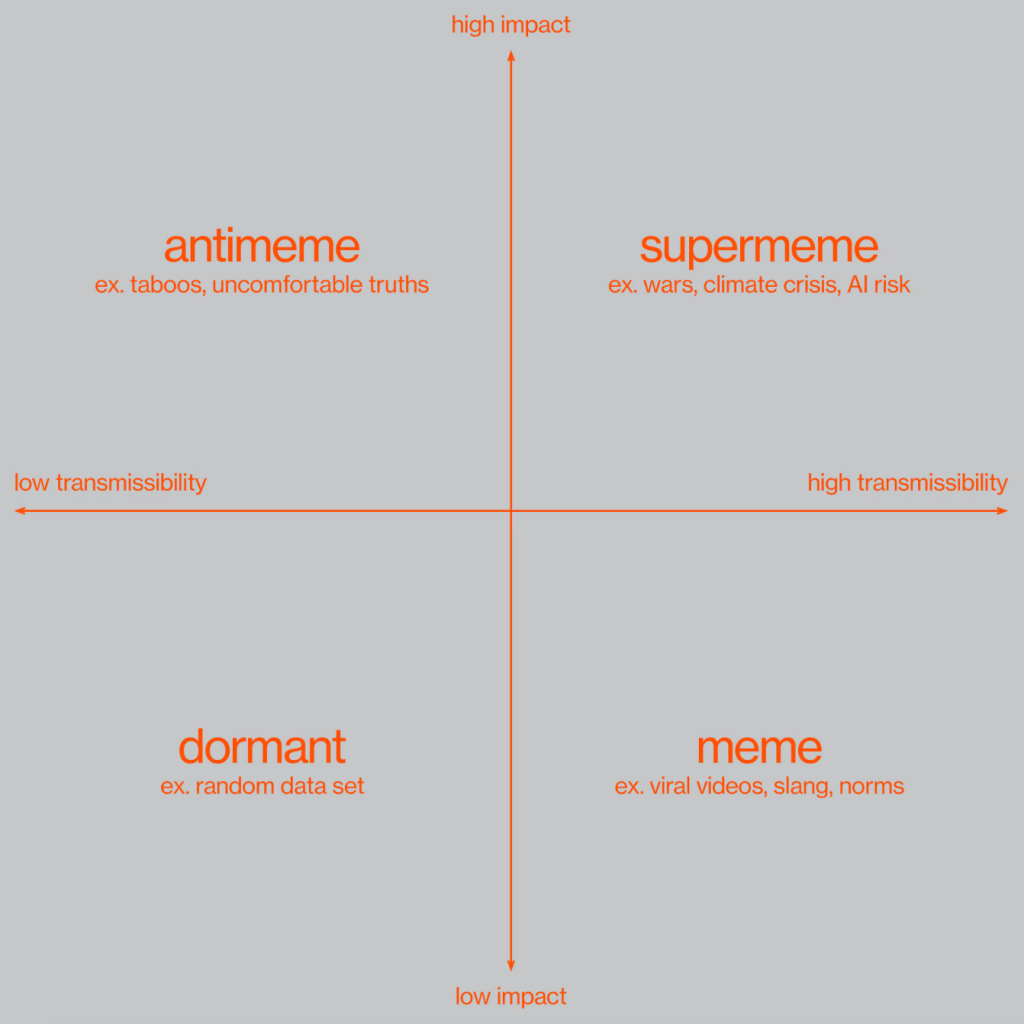
Here’s what’s interesting from a futures perspective: if attention is our main currency, then invisibility becomes a kind of resistance. The ideas that refuse to be broadcast: cooperative economies, regenerative systems, ways of valuing things beyond money. Those might be the real foundation of whatever comes after capitalism.

Bifo Berardi wrote about how late capitalism exhausts our attention, and how that exhaustion might open up new ways of thinking. David Graeber showed how everyday cultural practices can hide radical possibilities. Italo Calvino reminded us that entire worlds can exist in the imagination if we bother to look. They’re all pointing at the same thing: the invisible is where new worlds grow.

A century from now, you might look at Antimemetics as a snapshot of a weird transition period. A time when the most important ideas couldn’t compete for attention. When what shaped culture was as much about what was absent as what was everywhere. You might trace back to the quiet networks and experimental practices that survived in the margins The stuff we couldn’t see clearly but that somehow carried us forward. All our viral spectacles will look silly, but those invisible signals might be what actually mattered.

I’m writing this because paying attention is the first step of caring about something. Cultivating the invisible means cultivating possibility. Antimemetics teaches us to notice what resists the algorithm, to follow what doesn’t want to be broadcast, and to protect the seeds of ideas that might actually build something lasting.

Antimemetics: Why Some Ideas Resist Spreading


Imagining 2120: Generating Desire for Postcapitalism

Dear 2120,

Writing to you feels weird. Like texting someone who won’t read it for a century. But here we are, stuck between a world that’s clearly breaking and one we haven’t figured out how to build yet.

Here’s the thing: we’re supposed to imagine the future, but we’re really bad at it. Most of what we get fed is either dystopian nightmares or the same capitalism we have now, just with fancier phones and flooded cities. Mark Fisher (quoting Jameson) said it’s easier to imagine the end of the world than the end of capitalism. He/they nailed it.

But something’s definitely shifting. People are starting to realize that what we want – like, actually want – matters politically. Our desires either keep this broken system running or help bring something new into being.

Ursula Le Guin said the future is a kind of fiction, and she was right. We don’t have to accept Silicon Valley’s depressing version as the only story. We can write different ones. Slower, weirder, more human.

There’s this idea from Jacques Attali that every dying system contains hints of what comes next. And yeah, we’re definitely dying; supply chains failing, climate chaos, institutions crumbling. But in all that noise, we’re hearing something else. Mutualism replacing rigid hierarchies. Local communities thriving within global networks. Economies that measure health instead of just growth. The next thing isn’t going to show up complete, it’s emerging in pieces, visible in the cracks.

The problem is we’ve been trained to want the wrong things. We’re addicted to ownership, competition, endless accumulation – and these habits keep us locked into a system that’s literally killing us. Even people who want change often want it to be easy, comfortable, something they can buy into without real disruption.

So the challenge isn’t just building new systems. It’s rewiring how we imagine life itself. Making the postcapitalist world feel not just possible but genuinely desirable.

What if creativity wasn’t about competing but about contributing? What if technology helped people and ecosystems thrive instead of extracting from them? What if pleasure came from connection rather than consumption? What if status meant what you gave, not what you owned? What if growth meant maturing, not just expanding?

Writing to you instead of just about you changes something. It makes you real – not some abstract concept but someone we’re in relationship with. You’re not a prediction; you’re who comes after us. And you’ll inherit both our mess and whatever we manage to get right.

We’re trying to build you something that doesn’t eat itself. A world where abundance is about ecology, not money. Where resilience is collective, not just a personal brand. Where liberation includes everyone or it’s meaningless.

If we pull this off, your world will seem obvious. Just like feudalism looks absurd to us now, our obsession with markets and competition and individual success will seem embarrassingly primitive to you. Maybe you’ll laugh at how we measured everything in productivity and profit. Or maybe you’ll just be relieved we finally moved on.

I’m not writing this as prophecy – more like a reminder that we can shape what we want. Desire isn’t fixed. We can redirect it. The future isn’t something we just watch happen. It’s something we create.

If we learn to want different things, we’ll build different things.

And if we build different things, maybe you’ll inherit a world that actually works.

We’re still figuring it out. But we are actually trying.