Antimemetics: The Death of the ‘When’ Meme

Dear 2120,

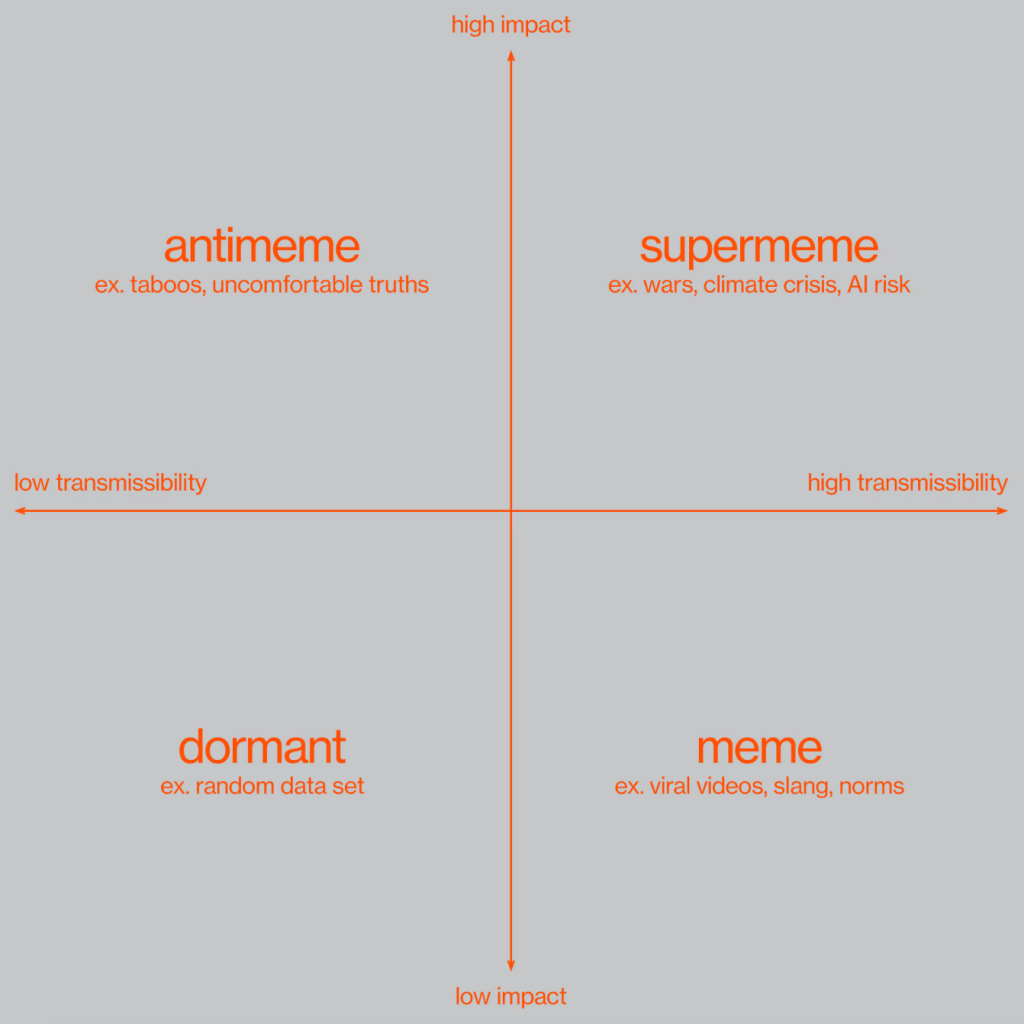
I want to tell you about a book called Antimemetics and why it matters – both now and hopefully for you too. It’s about ideas that don’t spread. Not because they’re bad, but because they’re too complex, too uncomfortable, or too inconvenient to go viral. Memes spread everywhere. Antimemes just… vanish. They leave barely any trace except in quiet corners where people are actually paying attention.

This hits different right now, to stay in the parlance of meme culture, because of how our platforms work. Everything’s optimized for speed and visibility. The ideas that win aren’t the most important ones – they’re just the loudest, the catchiest, the most entertaining. Meanwhile, the slow stuff, the complicated truths about climate and justice and how we actually relate to each other get buried. Antimemetics gives us language for that. For what disappears even though it matters.

Here’s what’s interesting from a futures perspective: if attention is our main currency, then invisibility becomes a kind of resistance. The ideas that refuse to be broadcast: cooperative economies, regenerative systems, ways of valuing things beyond money. Those might be the real foundation of whatever comes after capitalism.

Bifo Berardi wrote about how late capitalism exhausts our attention, and how that exhaustion might open up new ways of thinking. David Graeber showed how everyday cultural practices can hide radical possibilities. Italo Calvino reminded us that entire worlds can exist in the imagination if we bother to look. They’re all pointing at the same thing: the invisible is where new worlds grow.

A century from now, you might look at Antimemetics as a snapshot of a weird transition period. A time when the most important ideas couldn’t compete for attention. When what shaped culture was as much about what was absent as what was everywhere. You might trace back to the quiet networks and experimental practices that survived in the margins The stuff we couldn’t see clearly but that somehow carried us forward. All our viral spectacles will look silly, but those invisible signals might be what actually mattered.

I’m writing this because paying attention is the first step of caring about something. Cultivating the invisible means cultivating possibility. Antimemetics teaches us to notice what resists the algorithm, to follow what doesn’t want to be broadcast, and to protect the seeds of ideas that might actually build something lasting.

Antimemetics: Why Some Ideas Resist Spreading


Imagining 2120: Generating Desire for Postcapitalism

Dear 2120,

Writing to you feels weird. Like texting someone who won’t read it for a century. But here we are, stuck between a world that’s clearly breaking and one we haven’t figured out how to build yet.

Here’s the thing: we’re supposed to imagine the future, but we’re really bad at it. Most of what we get fed is either dystopian nightmares or the same capitalism we have now, just with fancier phones and flooded cities. Mark Fisher (quoting Jameson) said it’s easier to imagine the end of the world than the end of capitalism. He/they nailed it.

But something’s definitely shifting. People are starting to realize that what we want – like, actually want – matters politically. Our desires either keep this broken system running or help bring something new into being.

Ursula Le Guin said the future is a kind of fiction, and she was right. We don’t have to accept Silicon Valley’s depressing version as the only story. We can write different ones. Slower, weirder, more human.

There’s this idea from Jacques Attali that every dying system contains hints of what comes next. And yeah, we’re definitely dying; supply chains failing, climate chaos, institutions crumbling. But in all that noise, we’re hearing something else. Mutualism replacing rigid hierarchies. Local communities thriving within global networks. Economies that measure health instead of just growth. The next thing isn’t going to show up complete, it’s emerging in pieces, visible in the cracks.

The problem is we’ve been trained to want the wrong things. We’re addicted to ownership, competition, endless accumulation – and these habits keep us locked into a system that’s literally killing us. Even people who want change often want it to be easy, comfortable, something they can buy into without real disruption.

So the challenge isn’t just building new systems. It’s rewiring how we imagine life itself. Making the postcapitalist world feel not just possible but genuinely desirable.

What if creativity wasn’t about competing but about contributing? What if technology helped people and ecosystems thrive instead of extracting from them? What if pleasure came from connection rather than consumption? What if status meant what you gave, not what you owned? What if growth meant maturing, not just expanding?

Writing to you instead of just about you changes something. It makes you real – not some abstract concept but someone we’re in relationship with. You’re not a prediction; you’re who comes after us. And you’ll inherit both our mess and whatever we manage to get right.

We’re trying to build you something that doesn’t eat itself. A world where abundance is about ecology, not money. Where resilience is collective, not just a personal brand. Where liberation includes everyone or it’s meaningless.

If we pull this off, your world will seem obvious. Just like feudalism looks absurd to us now, our obsession with markets and competition and individual success will seem embarrassingly primitive to you. Maybe you’ll laugh at how we measured everything in productivity and profit. Or maybe you’ll just be relieved we finally moved on.

I’m not writing this as prophecy – more like a reminder that we can shape what we want. Desire isn’t fixed. We can redirect it. The future isn’t something we just watch happen. It’s something we create.

If we learn to want different things, we’ll build different things.

And if we build different things, maybe you’ll inherit a world that actually works.

We’re still figuring it out. But we are actually trying.

At the Edge of Whatever’s Next

Dear 2120,

Four years have gone by since my last letter. Apologies. The years have been eventful. I have two kids now, and a bunch of other things eating up my time here in late-stage capitalism, rendering unpaid writing, ruminating on the state of the world, outside of my immediate priorities. Still, I managed to squeeze in this message from early 2025 to let you know how I’m doing.

I hope you’re hanging in there. Chances are you might not be hanging in there. If the recent trajectory maintains its exponential nosedive, the letter I’m currently writing will find you in some sort of next-level chaos that our tiny minds can’t even begin to comprehend. To put it bluntly, we’re doing a spectacularly shitty job of protecting the future. I don’t mean to sound needy or act all weird about it, but I genuinely hope you’re okay.  

As I type these words into an oligarch-powered digital void, the world’s dominant superpower is getting hijacked by power-hungry techno-authoritarians. It’s very intimidating, but not without its farcical, clown-like elements; it weirdly feels like we’re stuck in some future comedy sketch about the 2020s — with Trump playing the cartoonish capitalist villain, all filtered through whatever distorted, misremembering history books you guys have left. 

And that’s just politics. We’ve got a polycrisis on our hands:

  • Oceans being killed
  • Forests vanishing
  • Soil turning to dust
  • Big animals being wiped out
  • Insects disappearing
  • Mass extinctions accelerating
  • Plastic literally in our bloodstreams
  • Climate scientists basically screaming into the void
  • Endless wars and genocide   

Oh, and did I mention the asteroid coming to kills us all, or the methane bubble in the Arctic that might burst, annihilating every living thing in its wake like some flatulent sleeper assassin the size of a small country? Some academics are even saying that AI could mean the end of civilization. I mean…why not throw a flesh-eating, zombie-virus into the mix to keep things interesting?

The whole thing feels like whoever’s running this simulation suddenly got bored and started throwing random disasters at us. Like, ‘Let’s make Elon go off the rails! Send a hot, weird girl his way, make her break up with him and see what happens.’

Well, it worked, simulation overlords. I gotta say, though, in reference to Roy Logan in Succession: you’re not serious people. It feels like you’re just making shit up at this point. You’ve got him doing Nazi salutes, stirring up far-right chaos in Europe, and stealing social security numbers from senior citizens with the help of over-caffeinated teenage bros. X, formerly Twitter, the social media he bought for a cajilion dollars to spread his misinformation, is calling him “Hurt Copain” now, offering a little comic relief in dark and tumultuous times.

What isn’t funny, are the accelerationist aspirations of Curtis Yarvin, the rising idealogue whispering his ‘dark enlightenment’ talking points into Vice president JD Vance’s ears. According to the Guardian:

‘Yarvin, who considers liberal democracy as a decadent enemy to be dismantled, is intellectually influential on vice president-elect JD Vance and close to several proposed Trump appointees. The aftermath of Trump’s election victory has seen actions and rhetoric from Trump and his lieutenants that closely resemble Yarvin’s public proposals for taking autocratic power in America.’

My initial action to these extremist fringe ideas occupying such a pivotal position in contemporary geopolitics were shock and surprise. However, having thought about it for a little while, my more considered stance is that it sort of makes sense. I don’t agree with any of it, of course. But in a world so utterly disenchanted by hollow consumerism, whoever dares to champion the grand narrative, while turning up the amp on the pomp & populism, stands to gain everything. We’re essentially numb from too much information and starved from too little meaning—and we’ll watch whatever trauma-pornographic Netflix show that ‘s on offer or latch onto any seemingly meaningful movement to feel something, anything.

In The Crisis of Narration, Byung Chul Han argues that our information-saturated society has undermined a fundamental human practice: narration.

While therapists practicing cognitive behavioral therapy encourage patients to examine their internal narratives, and politicians craft storylines to maintain their base, Han contends these are narratives in name only—lacking the profound world-shaping quality of myths or religious ceremonies. Genuine narration, according to Han, “combines events and objects, even seemingly trivial, minor, or random things, into a coherent story.” Put differently, true narration infuses our surroundings with meaning.

To sum up: neoliberalism and its digital byproduct, the relentless cascade of online information distributed via social media, has drained the world of color, leaving us begging for meager scraps from the numbing entertainment matrix, as well as apathetic, directionless and susceptible to domination.

I’m tempted to call this a non-stop tragicomical clusterfuck with no end in sight. Nobody has a clue where we’re heading, even if they pretend otherwise. It’s probably gonna get a whole lot worse before it gets better.

Or I don’t know…maybe this cartoon villany will come crashing down sooner than expected. They’ve certainly proved their glaring and goofy incompetence on more than one occasion. Let’s hope these are the last, somewhat bizarre, death throes of a dying paradigm.

Wish you could send something back. You know how it plays out. I don’t have the slightest idea. Maybe those UFO-sightings in New Jersey were you trying to get through to us?

In any case, it’s getting weird out here.