Dear 2120,
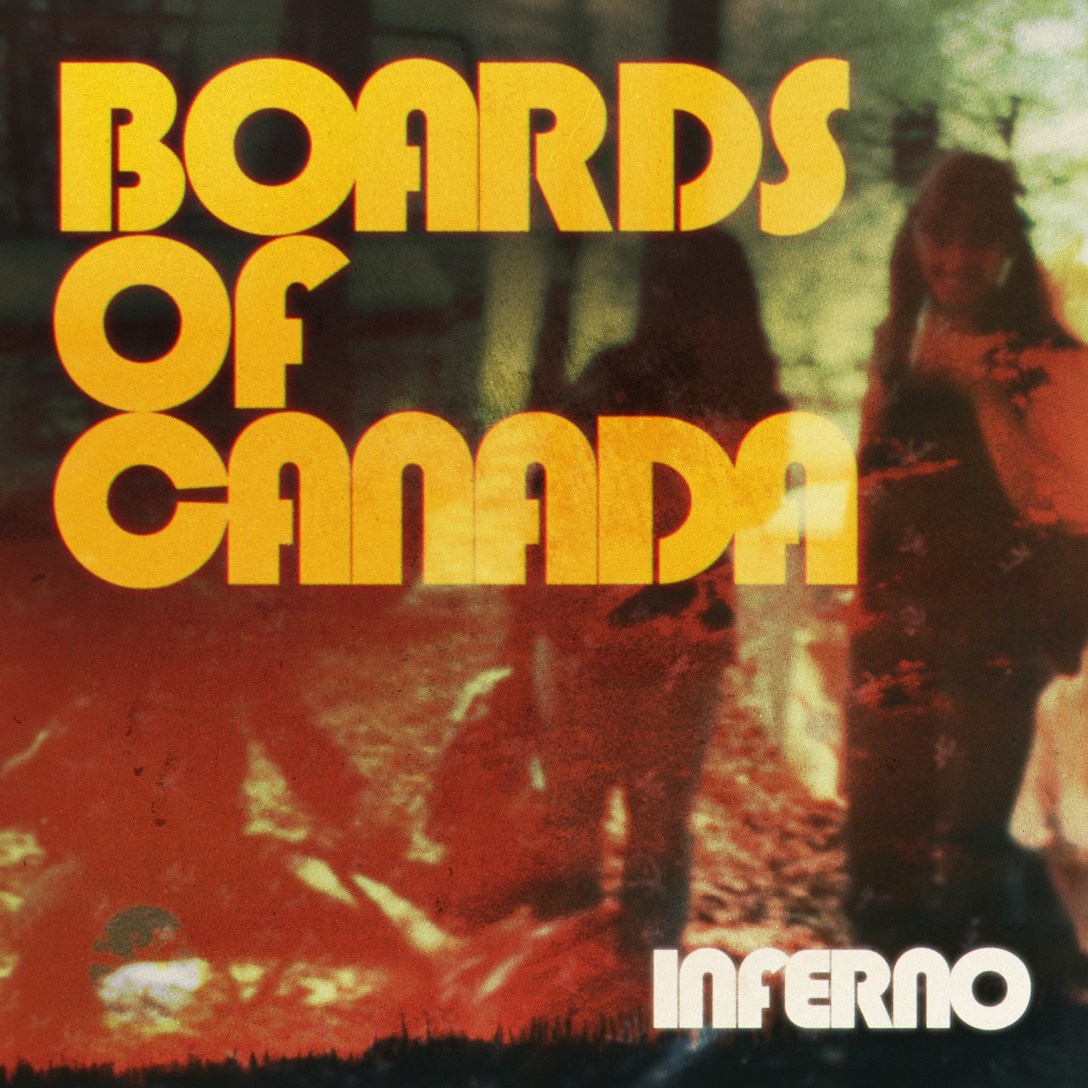
I’m sending you a message about the new Boards of Canada album. It’s called Inferno, and it’s the mysterious Scottish duo’s first LP in 13 years. To you this album isn’t new. It’s nearly a century old. I’m bringing it up in this very one-sided conversation of ours because the music is what we call a sign of the times. It articulates what so many of us have been struggling to say. The confusion, the frustration, the anticipatory grief, the hyperobjective transformation happening in real-time, on our ever-restless screens as we worry about the kind of future our children will have to navigate. If you want to get a sense of what living right now actually feels like, this album is a pretty good place to start.
The metacrisis moment
Boards of Canada’s ominous hexagon sun
The endless theorizing about our volatile geopolitical moment – the metacrisis, the climate crisis, the Epstein files, AI, the genocide, the far-right resurgence; how these connect, intertwine and intersect, and what it all means – that’s been covered pretty exhaustively by our talking heads in the media.
Things are getting worse. They’ll quite likely get a lot worse before they get better. We’ve got a pretty good grasp of the intensifying change happening all around us. But up until now it’s been too complex and elusive to capture through art in a way that makes you feel what that feels like.
To put it another way, art made about the metacrisis has, up until now, always felt slightly off. Kind of dilettantish. Try-hard. And very performative. Regardless of the level of ambition or well-intentioned effort it has, with a few notable exceptions, fallen short of capturing the unadulterated mindfuck that is the 2020s. It fails because it tries to commentate on the crisis rather than inhabit it. It has watched it from afar, perched on its cozy institutionalized vantage point rather than channel and embody its deeply fucked up energy.
Somehow, Mike Sandison and Marcus Eoin have become the bearers and mediators of that energy. Wherever it is they live in rural Scotland is the nodal point, the lightning rod absorbing how we collectively careen on the edge of the abyss and stare deeper into it with every new calamity we’re confronted with by the unrelenting news cycle.
Head-pounding prophecy
Take the album’s first single Prophecy at 1420 Hz. Supported by a video created by visual artist Robert Beatty, it gets underway with a cinematic Middle-Eastern flute. In the video, swirling light shapes, bearing an uncanny resemblance to Israeli iron dome rockets launched against Gaza, create a visual framing for the flute as it leads us into what suddenly becomes a surprisingly goth affair with chiming, downcast guitar. What’s more, the sound design exhibits a textural digital crispness that feels invigoratingly sharp as it cuts through their trademark analogue haze with determined precision.
Not only that, but halfway through the track you realize that the BoC-brothers didn’t come to play on their fifth album as they summon a warped and demonic AI entity from another realm that’s possibly the future. ‘I AM GOD, THE ULTIMATE RESONANCE’ it proclaims – a genuine WTF moment for long-time BoC-fans like myself. Not because it isn’t amazing (it is) but, in my opinion, one of Boards of Canada’s greatest strengths has always lain in their subtlety. Their unparalleled ability for teasing out deep emotional resonance with few elements. Prophecy is an entirely different beast altogether; it throws the duo’s well-known talent for evocative restraint by the wayside and takes a big fucking swing in a glorious all-out assault on established good taste and expectation. By trading their signature analogue warmth for a colder digital signature Sandison and Eoin could be admitting that the past can no longer protect us. The comforting retro-haze of the 20th century has officially curdled into the hyper-accelerated digital panic of 2026. They aren’t looking back anymore; they’ve been forced to look forward, and it sounds terrified and terrifying.
I was completely floored on the first 20 listens. It’s Boards of Canada, but from some alternately evolving timeline – which probably has a lot to do with the alternating times we live in. The strength of Prophecy was actually so impactful that it created the paradoxical effect of making me ever so slightly nervous that the brothers had pulled out their biggest gun early in the game in a marketing ploy to sell more records (hey, we all live in late capitalism – Warp Records are no exception).
Thankfully, my fears were put to rest when I finally sat down and listened to the whole entire thing. This wildly rich and expansive journey through space and time. People are comparing it to Pink Floyd’s Dark Side of the Moon. With the exception of The Guardian who lambasted the drum programming and what they thought was dubious interrogation of religion, the critics love it, too. Rarely have so many reviews become thinkpieces stepping out of the traditional music review framework. And with good reason; Inferno is just so interesting sonically and thematically. It prompts wider and deeper analysis. Which brings us to:
The Boards of Canada lore
Every Boards of Canada album launch is surrounded by intense speculation and relentless analysis. Every little detail is pored over, no aural stone is left unturned. The music is littered with symbolism, allusion, nods, winks and all kinds of surreptitious narratives often pulled from esoteric and occult sources. Inferno is no exception. In fact, it just might be their most reference-laden album yet.
To be honest with you, I never went too deeply into all that stuff. I’ve always been fairly crap at math, and I thought dissecting and arguing about possible interpretations of a given 70s sample on obscure message boards were for budding incels and people with an abundance of time on their hands. Up until now, I’ve just enjoyed the way the music makes me feel. However, with the launch of Inferno, I’ve changed my mind a bit. The references and the symbolism lend the listening experience an intellectual and thematic framework that you’ll be hard pressed to find on other contemporary albums.
Here’s a small fraction of Inferno lore lifted and repurposed from the delightfully nerdy Bocpages
| Track Highlight | Esoteric & Occult Allusions | Scientific / Mathematical Anchor |
| ‘Introit’ | Liturgical introduction opening a Christian holy communion mass. | Sets the thematic baseline of structural ritualism. |
| ‘Prophecy at 1420 MHz’ | Features Islamic scholar Seyyed Hossein Nasr declaring God as the ultimate resonance. | Points to the 1420.4 MHz hydrogen line frequency targeted by SETI for extraterrestrial life detection. |
| ‘Age of Capricorn’ | Samples a Christian televangelist weaving prophecies of the antichrist and Nostradamus’s “Mabus.” | Direct astrological nod to the zodiac age succeeding the idealized Age of Aquarius. |
| ‘Naraka’ | References the distinct purgatory/hell realm found in traditional Buddhist and Hindu theology. | Combines murky, low-end bass with ecstatic, looped Hare Krishna chanting. |
| ‘The Process’ | Evokes the 1960s apocalyptic cult, The Process Church of the Final Judgement. | Mimics an automated, algorithmic breakdown using distorted, synthesized text-to-speech word salad. |
| ‘I Saw Through Platonia’ | Interrogates the absolute loss of linear temporal movement. | Concept from physicist Julian Barbour suggesting time is an illusion; built completely over a raw human heartbeat. |
As you can probably tell, Boards of Canada don’t play when it comes to their conceptual storytelling. You could spend decades decoding the music (as I’m sure many people have), and still not get to grips with everything.
The sound of now
But what of the music itself? How does it actually sound as a cohesive body of work, and how does it make you feel? Speaking from within the 2026 context, my main takeaway is that it has reawakened my aural curiosity and to some extent my belief in music as a catalyst for transformation. That’s no small thing, obviously. Again, this is because it feels like the duo inhabit the zeitgeist rather than produce perspectives on it. Inferno is on fire in the best possible way:
There’s the upliftingly sinister vibe on Age of Capricorn where a faded voice switches between ‘Mabus’ (a predecessor to the third antichrist, or the antichrist itself, according to Nostradamus) and simply ‘marvellous.’ It’s hard to tell the words apart. Needless to say, the ambiguity is something else.
Then there’s Naraka, a bass weighty banger full of dread and danceable hooks that ends in joyfully uttered Hare Krishna samples. This would be corny AF on any other record than this (I’m still not completely sold on it, to be honest, but when you’re dealing with an LP of this magnitude – and all-out conviction – you tend to give it the benefit of the doubt).
Further on, Into the Magic Land hits an emotional register I can only describe – somewhat feebly and reaching – as out of this world. Interdimensional. From some place I know very intimately, but also feels decidedly alien. It’s a sort of comforting eeriness that envelops you, making you feel warm and cold simultaneously. It’s genuinely new in some way I struggle to describe. Maybe that’s why it’s so uncanny.
On Blood in the Labyrinth, you get the sense of a duo becoming increasingly emboldened in their newfound stylistic groove as they introduce a sitar, infusing the track with a 60s-psychedelia filtered-through-a-20s-lens vibe.
And You Retreat in Time and Space is a French Touch moment with disco-noir vibrations suddenly pierced by cacophonous sci-fi blockbuster brass noise that might not sound out of place on Daft Punk’s Random Access Memories – from the upside down.
Underneath it all I’m hearing multiple musical currents run in and out of the foreground: tinges of kraut-rock, generous helpings of Italian horror maestro Dario Argento’s opulent synth-driven soundtracks – and maybe even a bit of classic Dopplereffekt electro.
Questions to explore
Let it be said that I’m a die-hard fan. I’m more biased than most, but if I pull my head out of my ass for a split-second or two I might say: Boards of Canada are electronic music royalty living in complete isolation in rural Scotland, entirely insulated from the physical realities of the genocides, climate collapses, and economic ruin they are supposedly mediating. Isn’t there a deep, hypocritical paradox that I’m letting them slide on – blinded as I am by their creative fortitude? Is their hyper-isolated silence a form of artistic purity, or is it the ultimate luxury of privilege, withdrawing into a Scottish fortress to aestheticize our suffering into expensive vinyl packages and deluxe flexi-discs for late capitalism?
Much to consider. For now, I’ll let the answers to those questions blow in the temperate Scottish winds. The seeming contradictions won’t detract from my profound enjoyment of this headfuck of an album.
I could ramble on about Inferno for days on end. Its warm and creeping dread. The way it activates parts of your memory that makes you feel like you’re communicating with another version of yourself. Ultimately, words fail to do it justice. It’s just that good. You’ll need to listen for yourself in a little under a hundred years.
This is the end
I will say this, though. For me, personally, its greatest feat is creating a space for emerging emotions. For a world in visceral transition. There’s religion in there, sure, but that feels like a gateway to something else. Something to do with capturing a rapidly evolving collective consciousness. And possibly a way of alleviating your fears and thus dissolving your apathy by naming and exploring their causes.
All that’s left to say now is that Inferno feels like a big deal in 2026. It makes you feel like you’re a teenager again doing homework you actually enjoy. The metacrisis art that fails makes you feel implicated, guilty, overwhelmed. This makes you feel curious. Engaged. Like the world is still worth figuring out. That’s not a small thing in 2026.
I hope you’re listening in 2120.
Inferno by Boards of Canada is out now on Warp Records.


